
We are seeking investment and/or recruiting crew for the following projects. If you are interested for certain kinds of cooperation, please contact us for discussion.
SLEP – Solar Laser-Enabled Propulsion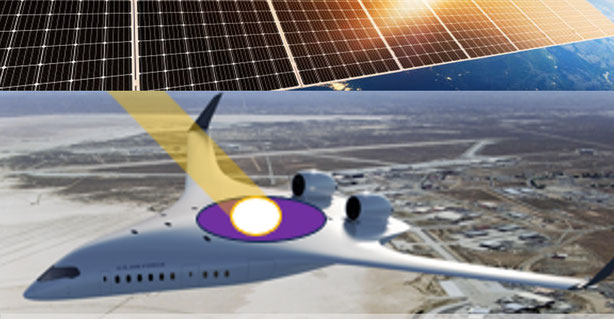
SLEP uses StarPower Stations (SPS, solar energy collection satellites) deployed on MEO to convert solar energy into electrical energy to power lasers that are aimed at high-altitude aircraft with laser receivers. The laser receivers concentrate energy on the “laser ramjet engine” to provide unlimited air flight time. The notion, developed with WidgetBlender, won the first place of NASA’s Brilliant Minds for Pure Blue Skies Challenge and has great potential for expanded applications. SPS, when in locations with few aircraft, can also beam power to lunar bases in the lunar night, space craft for laser propulsion, orbital debris reduction and Earth surface operations such as nighttime cloud evaporation, tornado damage, backfire settings against wildfires. Bersama (2026) is the Sci-Fi version of this work (see Solus Saga).
Motosonics
Motosonics offers a space ultrasonic application series. The current portfolio, developed with WidgetBlender, includes several winning concepts to manage the motion of fluids and solids in microgravity. USAV (2024) is an ultrasonic/sensing active solution to help propellant tank venting in microgravity with minimal loss of propellant. ASEAR (2022) used ultrasound with CO2 reused from the CO2 scrubbers on the spacecraft for ash removal from a trash-to-gas reactor in microgravity. GIPS (2023) incorporated ultrasound speakers to separate and remove fine carbon particles safely and efficiently from a Bosch reactor, without impacting its performance. On the other hand, certain Earth ultrasonic applications may be also presented.
Orbital Guards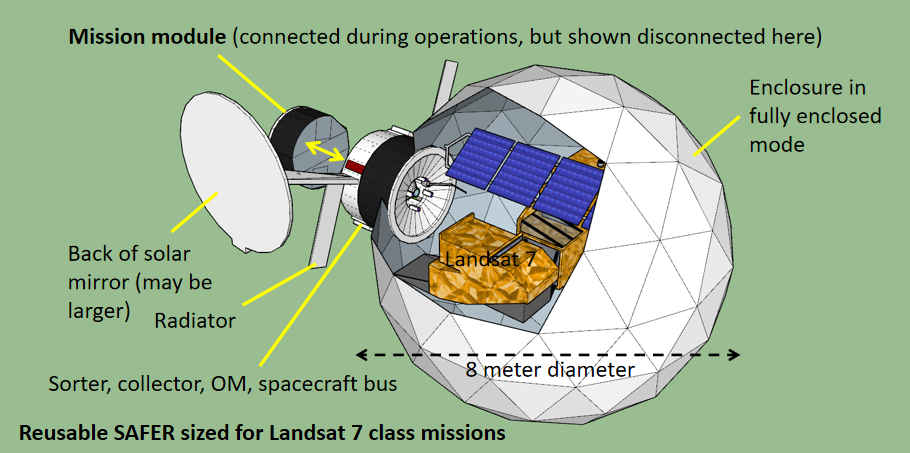
Orbital Guards includes a series of winning solutions, developed with WidgetBlender, for orbital debris risk mitigation. BioLeach (2022) is a bioleaching-based bioreactor module that can be used to recycle a variety of metals from space debris. It can be included in SAFER (2022) which uses reflected solar energy to break down, sort and refine parts of large satellites into useful inputs to other LEO operations, or other larger space artifacts. Debris Skimmer (2023) adapted crossbow concepts to design a 3U cubesat that uses minimal fuel to deorbit many < 10 cm orbital objects in a single mission, leading to an affordable orbital debris solution. On the other hand, WidgetBlender’s CODMS (marketing name: OrbitSweeper) described a capture-less orbital debris management system, which is patent granted (2025).